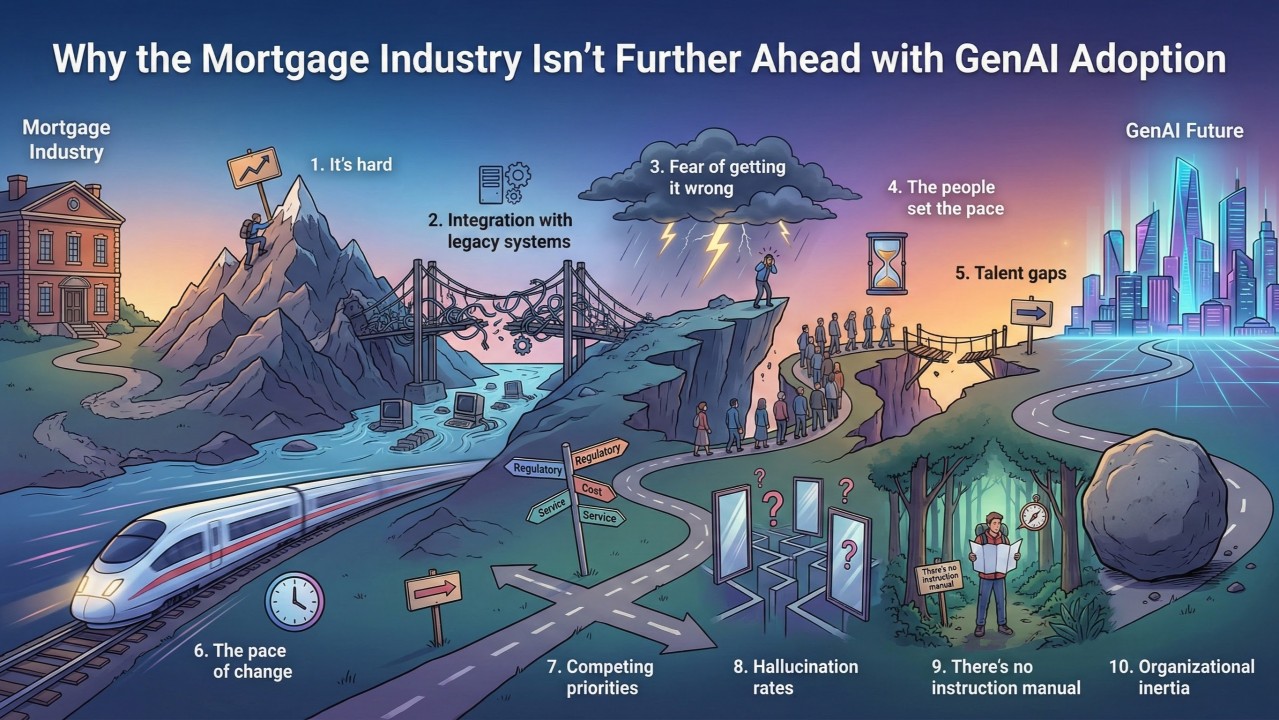
I got asked a really excellent question yesterday: "Why isn't the mortgage industry further along with genAI adoption?". I really should have had a better answer, given that my one job is to help the industry adopt genAI and I pretty much eat, sleep, and breathe mortgage AI. I just hadn't really sat down to formulate my thoughts, and my answer was pretty meh. So I had time this morning to do a better job. Here's my take, in no particular order.
It's hard. I have a commercial product in addition to observing and partnering with organizations to scale genAI solutions and it's just really hard. The tech can be fragile. There is an enormous amount of error analysis to do if you want to get it right. Mortgage is flooded with choices (so many amazing genAI demos by vendors, so few credible evaluation results), creating decision fatigue. There is so much to learn and figuring out the core tech is challenging.
The industry technology ecosystem is still sandwiched between tech that was already aging, and the constellation of wrap and ancillary applications that sprouted up post 2008. The ecosystem is unbelievably complex, numerous workarounds and control reports supplant humans that have to make the tech work to get things done. We have multiple lines of defense used to verify that the technology has done the right thing. Often, we see four lines of review for one decision. That's really challenging to integrate with.
Pre-genAI there were already hundreds of thousands of rules to implement to make and service a mortgage. Maybe 150,000 rules, and at least a million pages of documents to comply with. And that was before genAI. The consequences of "getting things wrong" were already high. Fines, buybacks, consent orders... not mention the financial and emotional costs to the homeowners. Getting it wrong is a big deal. Now enter genAI. It will never be 100% correct. It just won't, that's not how it works. In an industry where perfection is the standard (even though the humans in the process are not perfect) it's hard to introduce technology that is not rules-based.
I often make the mistake, like many of us do, of thinking that everyone thinks like I do. I eat new technology for breakfast. I thrive in uncertainty. I enjoy the pressure created when the stakes are high. I like change, it keeps things interesting. This is a very myopic way of thinking. Everyone does not think like I do, and what a boring, chaotic world that would be if they did. Each human on this AI journey is on, well, their own personal journey. We can buy all the tech we want, and eventually, even with AI, there's a person somewhere who has to use it or derive value from it. It's not the tech that sets the pace, it's the people. And frankly, I'm kind of grateful for that. AI headlines are kind of scary. Maybe the human adoption throttle is a good thing.
Unless we have bajillions of dollars, the talent bar is so high that it's effectively unachievable. We are all looking for these unicorns - these super savvy, genAI native, AI experts who know mortgage and have people skills. All for like $150K. Guess what guys, not happening. So we all have to kind of fumble around to find the talent, grow the talent, partner to acquire the talent. It's just really hard. And it's really hard to actually tell where the tech really is. What can actually be implemented safely and at scale? You literally have to troll the developer community to see what the real deal is with agents. There are so many powerpoints. Who has time to sift through them all and then pressure test them? And then there's all the completely-unsexy-yet-utterly-neccessary error analysis. Guess what? That takes humans who really know the business. You know where those people are? Yeah, they are in the business.
This one is really daunting, even for me and this is my whole job. The pace of change is unlike anything I have ever seen in 25 years of tech. I don't have a fancy silicon valley pedigree, but I sure spend a lot of time making up for it and I just can't keep up with every aspect of every potentially useful thing in the AI space. I can't go to every conference, and even if I could, it still wouldn't be enough. Just when we think we figured something out, there's the next new thing. RAG was it, then agents were it, then agentic workflow was it, now it's neurosymbolic AI. There is not an organization in the world of any size that can ingest this kind of change in an immediately productive way.
We all have lives to care for, many of us have families to feed (or at least a cat or houseplant). We are all running a business in one of the most uncertain times of our country's history. We all want to create time and space to experiment and learn. But we still have beans to count, and we only count two types of beans in mortgage - heads and dollars. That's just the way it is. So the pressure to generate revenue or reduce expense is absolutely unrelenting. And that's not going to stop. It takes a truly rare executive team with the emotional and intestinal fortitude to invest what it takes to figure all this out.
Then there's just the basic fact of hallucination rates. It's a thing. In order to produce the truly fantastic results we can get out of a large language model, we must be able to accept variability - and that variability can be inaccurate. Say it with me now folks, this is probabilistic technology. If you need 100% accurate answers 100% of the time, genAI is not for you. But I will challenge the idea that we actually need 100% accurate 100% of the time in mortgage. Mostly because I know with 100% certainty that we don't have it today. This requires what Sequoia has called a stochastic mindset shift (I wrote about this here).
Yes, we operate in a completely rules based industry. But is it really? What about all that interpretation that we have to do to the federal rule set? What about all those VA circulars? Lender letters? We already don't have an instruction manual, and now we add still-in-the-oven paradigm changing technology to the mix. Talent gaps. No help from regulators or the white house. The state patchwork. It's a mess, and we take all the risk ourselves. We take all the learning on our own. It's just really hard.
Moving an organization of any size (even a small size) is hard. We just are ingrained in how we do what we do. Every system is perfectly designed to produce the result it produces. We have settled into a way that we understand, doing a thing we know. The weight of what we have built, especially in mortgage, holds us down. 2008 crushed us all. That's where these four lines of defense came from. TRID crushed us all. It literally cost tens to hundreds of millions of dollars to implement change of that size. Everything about our organizations are optimized to carry that weight. We are stuck, all of us.
I added this one after thinking through this for a while, so unfortunately my top ten list is now a top eleven list. So much for clickbait. It's very hard to reimagine what we do. Even if we can reimagine it, then we have to make it real. A great example is the regulatory change process. The true cost of regulatory change is not tracked, not really. It is a fantastically distributed process that touches every single part of our organizations and all the technology and people involved. From the attorney that summarizes the change, to the tester working for a third party vendor who implements a piece of code the changes a calculation. No one counts all those steps. We don't know what it really takes, what it really costs. And if we don't know how it is, it's very hard to know how it could be.
So there you have it, faithful readers, if you're out there. My top eleven reasons why we are not further along with this genAI thing. Do not despair, however, the change is here and the time is now. We'll get through it eventually, we always do.
By Tela Mathias, Chief Nerd and Mad Scientist, PhoenixTeam | CEO, Phoenix Burst